Featured Articles

Intel plans Haswell refresh in Q2 2014

Intel plans Haswell refresh in Q2 2014

Intel has been executing its tick tock strategy flawlessly since January 2006 and now there is some indication that we might…

More...
Xbox One demoed running GTX card

Xbox One demoed running GTX card

It looks like the Xbox One just cannot catch a break. We have stumbled upon a report claiming that Xbox One…

More...
Haswell Pentium and Core specs surface

Haswell Pentium and Core specs surface

Haswell is out and now we have the complete specs for Intel’s first batch of fourth generation Core parts, as well…

More...
EVGA GTX 770 ACX 2GB previewed

EVGA GTX 770 ACX 2GB previewed

Nvidia is hoping that the Geforce GTX 770 will be a very popular product, and EVGA obviously share this view, as…

More...
Gainward GTX 770 Phantom reviewed

Gainward GTX 770 Phantom reviewed

Gainward has now officially unveiled its custom version of the Geforce GTX 770, the Gainward GTX 770 Phantom. Based on the…

More...
Frontpage Slideshow | Copyright © 2006-2010 orks, a business unit of Nuevvo Webware Ltd.
Saturday, 28 April 2007 21:14

MSI hits 1333 MHz FSB

Written by Eliot Kucharik


ImageImage

Preview: Overclocking the MSI P6N-SLI Platinum


We are
still playing with the MSI P6N-SLI Platinum motherboard and we showed you the first part here.


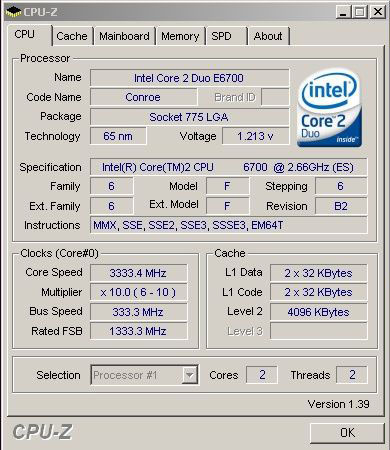
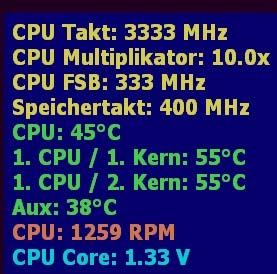
First we were interested if the board will support the FSB 1333 (333.33MHz for real) as stated. You can select this without changing any voltages on the chipset or FSB. We increased the CPU Vcore by +0.200V to make sure the CPU won't be the limiting factor.

Booting went without any issues even when the BIOS warned that "This CPU only supports 266.67MHz FSB". You have to watch the chipset temperatures closely. Without proper chipset cooling the board will crash, because the Northbridge hits the 60°C mark.

Make sure you have a top blower CPU-Cooler and either use the added 4cm fan for the Northbridge or a proper case-cooling. The 4cm fan is incredibly loud and therefore we can't recommend its usage.

The good news is that FSB 1333 or 333.33 MHz works very well and we are about to move to faster frequencies. But doesn't 3333.4 MHz with an FSB at 333.33 MHz look cool? More soon.
  Image

Image

Last modified on Sunday, 29 April 2007 19:03
blog comments powered by Disqus

To be able to post comments please log-in with Disqus


Facebook activity

Latest Commented Articles

Recent Comments