Featured Articles

After USA Nvidia’s Shield comes elsewhere

After USA Nvidia’s Shield comes elsewhere

Project Shield, which is now called Nvidia Shield, is up for preorder, at least if you’re in North America. For…

More...
Nvidia won most Haswell high-end notebooks

Nvidia won most Haswell high-end notebooks

Our sources in the Far East are claiming that most Haswell notebooks that are coming out in the next few weeks…

More...
Microsoft officially announces the Xbox One

Microsoft officially announces the Xbox One

As announced earlier, Microsoft has now finally unveiled its next-generation console, the Xbox One. Although it did not shed much light…

More...
AMD poaches more Nvidia talent

AMD poaches more Nvidia talent

AMD has apparently managed to grab yet another high-ranking Nvidian, but this time it was no engineer or developer.

More...
HIS iCooler Turbo HD 7790 reviewed

HIS iCooler Turbo HD 7790 reviewed

Today we’ll take a closer look at a factory overclocked HD 7790, courtesy of HIS. The HIS HD 7790 iCooler Turbo…

More...
Frontpage Slideshow | Copyright © 2006-2010 orks, a business unit of Nuevvo Webware Ltd.
Thursday, 26 May 2011 09:31

PoV / TGT GTX 560 Ultra Charged tested

Written by Sanjin Rados
thumb

Review: Breathing down GTX 560 Ti's neck  


With the company’s launch of Geforce GTX 560, Nvidia expanded its performance segment offer quite nicely. The GTX 560 can be found at €150, while the GTX 560 Ti is available for €30 more, here.

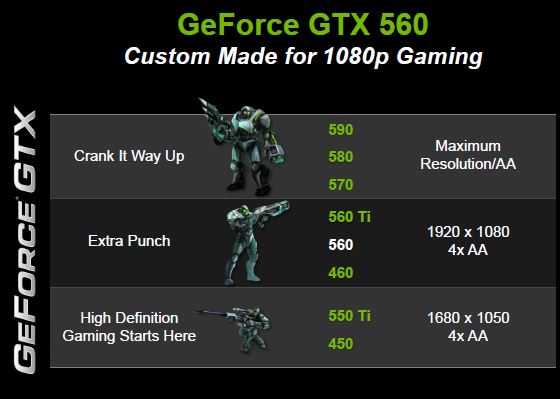
Both cards were classified as so called ‘gamers’ sweet spot’, meaning that gamers on average budgets will love it and should be pleased with the performance offered. Optimum gaming resolution is 1680x1050, although 1920x1080 is possible as well, albeit after sacrificing some detail settings.
front-4

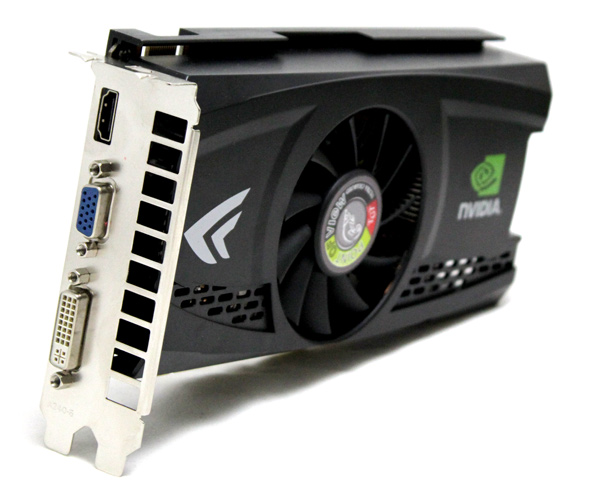
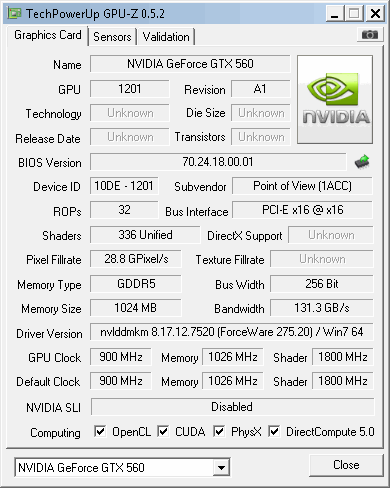
Thankfully, there’s always the option to overclock the card and allow for smooth 1920x1080 gaming ad Point of View/TGT did exactly that. In fact, PoV/TGT pushed the GTX 560 Ultra Charged Edition’s GPU from reference 810MHz to as high as 900MHz.
 

gpuz

GTX 560 cards are built around the GF114 GPU. Compared to the GF114 on GTX 560 Ti cards, the GTX 560’s GF114 comes with one Shader-cluster less. By disabling the Shader-cluster, GTX 560 practically got the same specs as the GTX 460 (GF104): 336 shaders or CUDA processors, 32 ROPs, 56 TMUs and 256-bit memory interface. Hardware wise, it’s the same configuration but the GTX 560’s GPU is 135MHz faster and its memory is faster by 100MHz (400MHz effectively) than GTX 460’s.

Thanks to the improved GPU design, Nvidia could clock the GF114 much higher than GTX 460’s clocks, all the while keeping consumption at the same level.
560_slide_1080p_gaming

Performance wise, the GTX 560 is somewhere between the GTX 460 and GTX 560 Ti, leaning more towards the latter.


  • «
  •  Start 
  •  Prev 
  •  1 
  •  2 
  •  3 
  •  4 
  •  5 
  •  6 
  •  7 
  •  8 
  •  9 
  •  10 
  •  Next 
  •  End 
  • »
(Page 1 of 11)
Last modified on Saturday, 04 June 2011 19:46
blog comments powered by Disqus

To be able to post comments please log-in with Disqus


Facebook activity

Latest Commented Articles

Recent Comments