Featured Articles

Gainward GTX 780 3GB previewed

Gainward GTX 780 3GB previewed

The Gainward GTX 780 is now available priced at about US $649/€649, but we're hoping it will be available for a…

More...
GTX 780 available in US stores

GTX 780 available in US stores

The GTX 780, a trimmed down version of the Geforce Titan, is out and we wrote that almost a dozen…

More...
Newegg claims Shield comes on June 30

Newegg claims Shield comes on June 30

It is no secret that for the last few days you can pre-order Nvidia Shield, at least if you are based…

More...
Nvidia officially launches the GTX 780

Nvidia officially launches the GTX 780

Just as we wrote a couple of days ago, Nvidia has picked the 23rd of May as the official launch date…

More...
HIS iCooler Turbo HD 7790 reviewed

HIS iCooler Turbo HD 7790 reviewed

Today we’ll take a closer look at a factory overclocked HD 7790, courtesy of HIS. The HIS HD 7790 iCooler Turbo…

More...
Frontpage Slideshow | Copyright © 2006-2010 orks, a business unit of Nuevvo Webware Ltd.
Wednesday, 11 January 2012 02:12

Broadcom demos reference 802.11ac

Written by Rob Squires

broadcom logo

CES 2012: 2Gbits per second

Broadcom is showing the latest in 802.11 technology at CES in their private suite. The latest iteration of 802.11ac promises Gigabit wireless speeds.

"5G WiFi" is the branding that Broadcom has chosen for their 802.11ac chipsets. Broadcom’s implementation of 802.11ac improves the wireless range in the home, allowing consumers to watch  HD-quality video from more devices, in more places, simultaneously.

The increased speed enables users to download web content from a mobile device faster and quickly sync large files, such  as videos, in a fraction of the time it would take on a similar 802.11n device.  The new IEEE 802.11ac chips are three times faster and up to six times more power efficient than equivalent 802.11n solutions.
bcm routerreference_performance 

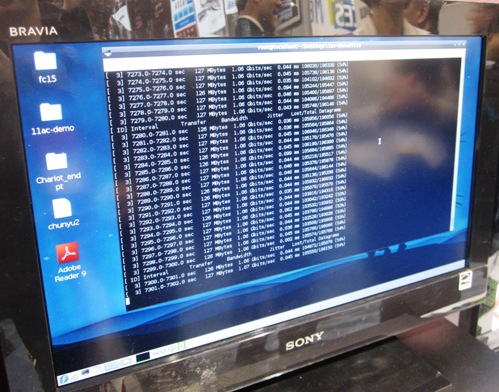
Broadcom announced four chips this week at CES. At the high end, the hardware supports three spatial streams and PHY (physical) rates of up to 1.3Gbps. Even at its low-end chip’s slowest speed though, a single-stream radio has a theoretical top speed of 433Mps which leaves 802.11n, where even multiple-stream devices don’t usually go over 300Mbps, eating its dust.

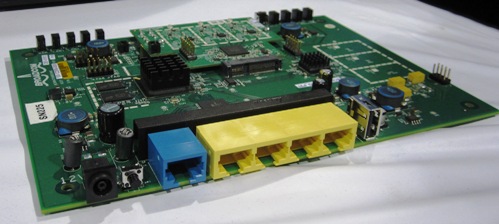
Although the 802.11ac is still being developed, Broadcom is already showing working silicon that meets the current pre-draft specifications of the IEEE standard. We managed to get pictures of their reference "performance" router design supporting 802.11ac as well as 802.11n radios.

This is how the router looks below.
bcm routerreference_front

bcm routerreference_top


Last modified on Wednesday, 11 January 2012 06:19
blog comments powered by Disqus

To be able to post comments please log-in with Disqus


Facebook activity

Latest Commented Articles

Recent Comments