Featured Articles

Nvidia GTX 770 spec is out

Nvidia GTX 770 spec is out

In addition to the GK110 based Nvidia Geforce GTX 780, we managed to get some details regarding the GK104-based GTX 770…

More...
Nvidia Geforce GTX 780 detailed

Nvidia Geforce GTX 780 detailed

We managed to confirm the full spec of the upcoming Nvidia Geforce GTX 780 graphics card as well as some performance…

More...
AMD shares take rollercoaster ride

AMD shares take rollercoaster ride

In the last 52 weeks AMD was on a rollercoaster ride, with prices ranging from $1.81 to $6.46. Yesterday it closed…

More...
HIS iCooler Turbo HD 7790 reviewed

HIS iCooler Turbo HD 7790 reviewed

Today we’ll take a closer look at a factory overclocked HD 7790, courtesy of HIS. The HIS HD 7790 iCooler Turbo…

More...
Kingston DataTraveler Ultimate 3.0 Generation 3 (32GB) reviewed

Kingston DataTraveler Ultimate 3.0 Generation 3 (32GB) reviewed

High capacity USB drives have become commonplace a while ago, but although some memory outfits are peddling huge drives, up…

More...
Frontpage Slideshow | Copyright © 2006-2010 orks, a business unit of Nuevvo Webware Ltd.
Monday, 10 December 2012 15:11

Zotac ZBOX Nano XS AD11 Plus reviewed - Temperatures, noise and power consumption

Written by Slobodan Simic

zboxnano logo recommended08 75

Review: Smallest ZBOX packs quite a punch


Temperatures, noise and power consumption

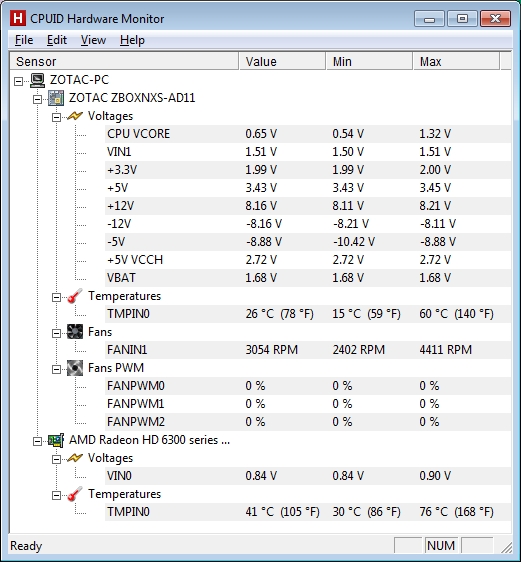
As you can see from the CPUID Hardware Monitor screenshot below, the APU works at anywhere between 15 and 60 degrees Celsius, while the graphics part goes from 30 to 76 degrees Celsius.
hwmonitor

The temperatures are quite understandable as due to its small size, the entire system is cooled by a single, relatively thin blower-style cooler that is in contact with both the E-450 APU and the A50M chipset. As you can see the fan, when set to work in smart mode in BIOS, spins anywhere between 2400 RPM and 4400RPM. Even at its highest 4400RPM value that we have seen, you can only hear it if you get close to it as it surprisingly does not produce a high-pitch sound that is characteristic of small fans.

Of course, bear in mind that these high values for both temperature and fan speed are achieved under full load and extensive benchmarking and it is highly unlikely that you’ll ever see those in normal usage.

Power consumption is pretty decent as according to our measurement it draws about 0.5W in standby, 12 to 14W in idle and up to 29W under full load. 
 

(Page 4 of 5)
Last modified on Monday, 10 December 2012 18:08
blog comments powered by Disqus

To be able to post comments please log-in with Disqus


Facebook activity

Latest Commented Articles

Recent Comments