Featured Articles

Nvidia GTX 770 spec is out

Nvidia GTX 770 spec is out

In addition to the GK110 based Nvidia Geforce GTX 780, we managed to get some details regarding the GK104-based GTX 770…

More...
Nvidia Geforce GTX 780 detailed

Nvidia Geforce GTX 780 detailed

We managed to confirm the full spec of the upcoming Nvidia Geforce GTX 780 graphics card as well as some performance…

More...
AMD shares take rollercoaster ride

AMD shares take rollercoaster ride

In the last 52 weeks AMD was on a rollercoaster ride, with prices ranging from $1.81 to $6.46. Yesterday it closed…

More...
HIS iCooler Turbo HD 7790 reviewed

HIS iCooler Turbo HD 7790 reviewed

Today we’ll take a closer look at a factory overclocked HD 7790, courtesy of HIS. The HIS HD 7790 iCooler Turbo…

More...
Kingston DataTraveler Ultimate 3.0 Generation 3 (32GB) reviewed

Kingston DataTraveler Ultimate 3.0 Generation 3 (32GB) reviewed

High capacity USB drives have become commonplace a while ago, but although some memory outfits are peddling huge drives, up…

More...
Frontpage Slideshow | Copyright © 2006-2010 orks, a business unit of Nuevvo Webware Ltd.
Tuesday, 26 July 2011 12:51

SanDisk releases new SSDs

Written by Nick Farell


Straight to consumers
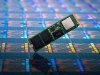
SanDisk has released a new line of solid-state drives (SSDs) that it's flogging directly to consumers rather than manufacturers.

The Ultra SSD line has been designed to replace hard drives in older systems and thereby increase the performance, durability and lifespan of existing laptops and desktops. It uses the SATA 2.0 specification I/O interface, and can manage a read rate of up to 280MB/sec and a  write rate of up to 270MB/sec.

The technology is based on multi-level cell (MLC) NAND flash memory, has a mean time between failure (MTBF) rate of up to one million hours.  Of course most people think that the MTBF is about as reliable a way of determine an SSD's longevity as counting the rings of dead coffee on my desk. SanDisk claims that replacing an existing hard drive with an SSD is more cost effective than purchasing a new computer. However it is still not nearly as cheap as a conventional hard-drive.

The drives arrive in 60GB, 120GB and 240GB capacities and will set you back $129.99, $219.99 and $449.99.
blog comments powered by Disqus

To be able to post comments please log-in with Disqus


Facebook activity

Latest Commented Articles

Recent Comments