A few days prior to Mobile World Congress 2012 in Barcelona, several smartphone vendors and SoC manufacturers have put it on themselves to one-up each other in competitive marketing leads before the official start of the show.
Nevertheless, Texas Instruments has released a marketing video comparing an Android tablet running one of its OMAP 5 SoCs (probably an OMAP5430) with its two ARM Cortex A15 cores clocked at 800MHz against an Nvidia Tegra 3 at 1.30GHz (approximate) with its four ARM Cortex A9 cores and additional power-efficient companion core, or "ninja core" (see: Nvidia 4-PLUS-1).
The video illustrates EEMBC's BrowsingBench benchmark test in which webpage loading speeds are measured in concurrency between the tablets and the total loading time is recorded at the end. According to the results, the TI OMAP5 tablet finishes its benchmark in 95 seconds whereas the Tegra 3 tablet finishes in 201 seconds. Of course, the benchmark is completely biased in its failure to compare individual page-by-page loading speeds with one another, as it simply runs through the entire benchmark and compares overall completion times. Despite being the faster SoC, it is possible that Texas Instruments may be called out by Nvidia for this, and we are interested to hear the conversation between the two SoC giants.
We have reason to believe that the unnamed quad-core Cortex A9 (Tegra 3) tablet is an ASUS Transformer Prime running Google Android 4.0 Ice Cream Sandwich. Meanwhile, we expect the unnamed dual-core Cortex A15 (OMAP5) tablet will be announced next week at Mobile World Congress.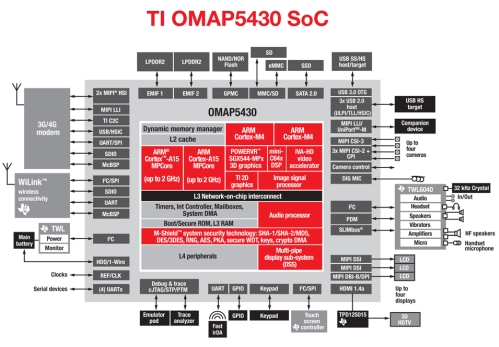
Texas Instruments 28nm OMAP5430 SoC with dual Cortex A15 MPCores and dual Cortex M4s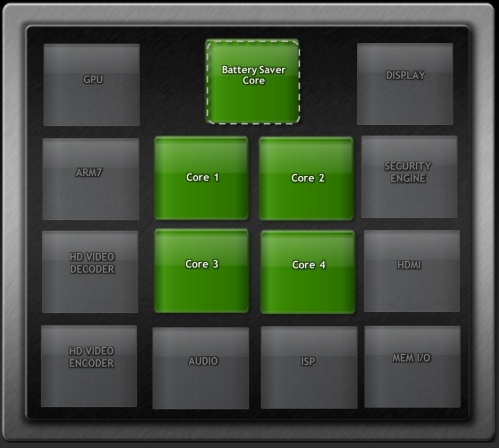
Nvidia 40nm Tegra 3 (4-PLUS-1) SoC with four + one Cortex A9s