Featured Articles

Microsoft officially announces the Xbox One

Microsoft officially announces the Xbox One

As announced earlier, Microsoft has now finally unveiled its next-generation console, the Xbox One. Although it did not shed much light…

More...
AMD poaches more Nvidia talent

AMD poaches more Nvidia talent

AMD has apparently managed to grab yet another high-ranking Nvidian, but this time it was no engineer or developer.

More...
Qualcomm and Samsung overtake AMD

Qualcomm and Samsung overtake AMD

It’s no secret that the mobile boom is taking a toll on makers of PC components and AMD is one of…

More...
Nvidia Geforce GTX 780 detailed

Nvidia Geforce GTX 780 detailed

We managed to confirm the full spec of the upcoming Nvidia Geforce GTX 780 graphics card as well as some performance…

More...
HIS iCooler Turbo HD 7790 reviewed

HIS iCooler Turbo HD 7790 reviewed

Today we’ll take a closer look at a factory overclocked HD 7790, courtesy of HIS. The HIS HD 7790 iCooler Turbo…

More...
Frontpage Slideshow | Copyright © 2006-2010 orks, a business unit of Nuevvo Webware Ltd.
Tuesday, 17 April 2012 16:01

Gainward GTX 680 Phantom 2GB tested - Termals, Noise and Power Consumption

Written by Sanjin Rados

phantom-gtx-680-thumbtop-value-2008-lr

Review:
Fingers crossed for Nvidia's response to AMD's price cuts

Thermals and Noise

Gainward GTX 680 Phantom temperatures go up from 72°C  to 77°C during gaming. This is excellent when taking into account the low noise levels. On the Gainward GTX 680 reference design temperatures go up to 80°C during gaming.

The GTX 680 Phantom’s fans are less noisy compared to reference GTX 680 ones. Note that there were no sudden changes in fan noise. However, two 8cm PWM fans tucked away in a special chamber within the heatsink does introduce one disadvantage - the card is 2.5 slots wide.
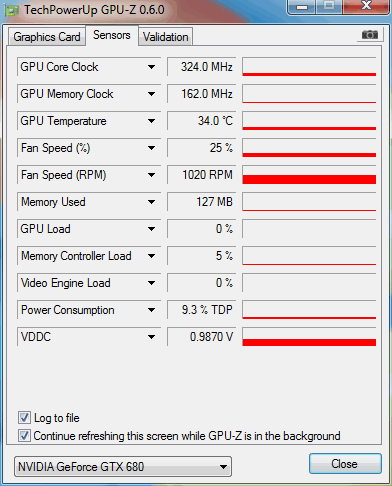
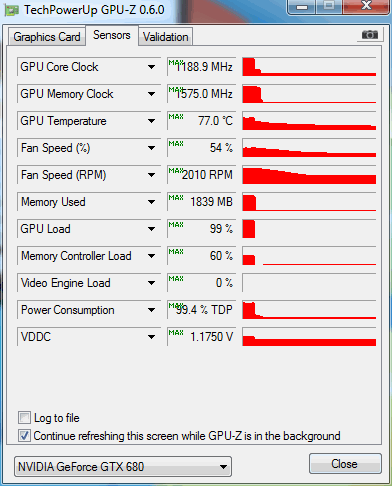
ganward phantom gpuz temp idle

gpuz voltage load

Note however the codependency between thermals and clock calculations, which may result in different performance depending on thermals. As soon as the card overheats, which causes current leakage increases, GPU Boost will decrease clocks and voltage.

Power Consumption

Gainward’s GTX 680 Phantom consumed not more than the same company’s reference version. GTX 680’s power consumption is a little better than that of its main competitor – HD 7970. However, AMD’s card boasts ZecoCore, a feature that shuts the card down once the display is off, which slashes consumption to mere 1W. The same scenario will see the GTX 680 consume about 14W. Still, GTX 680’s power management is definitely a job well done because the card scores more than 20% better than its predecessor GTX 580 while consuming 50W+ less.
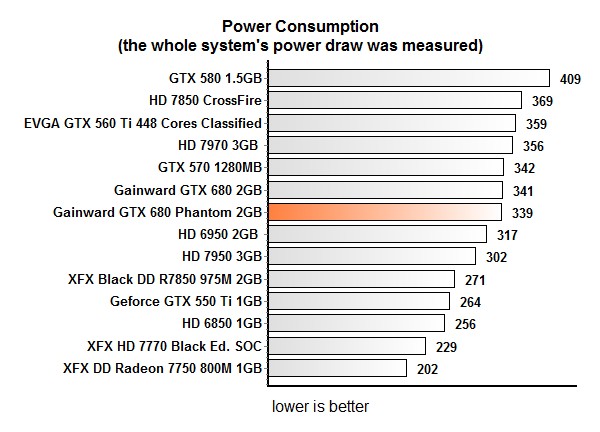

power


(Page 12 of 14)
Last modified on Saturday, 12 May 2012 09:56
blog comments powered by Disqus

To be able to post comments please log-in with Disqus


Facebook activity

Latest Commented Articles

Recent Comments