Featured Articles

Intel plans Haswell refresh in Q2 2014

Intel plans Haswell refresh in Q2 2014

Intel has been executing its tick tock strategy flawlessly since January 2006 and now there is some indication that we might…

More...
Xbox One demoed running GTX card

Xbox One demoed running GTX card

It looks like the Xbox One just cannot catch a break. We have stumbled upon a report claiming that Xbox One…

More...
Haswell Pentium and Core specs surface

Haswell Pentium and Core specs surface

Haswell is out and now we have the complete specs for Intel’s first batch of fourth generation Core parts, as well…

More...
EVGA GTX 770 ACX 2GB previewed

EVGA GTX 770 ACX 2GB previewed

Nvidia is hoping that the Geforce GTX 770 will be a very popular product, and EVGA obviously share this view, as…

More...
Gainward GTX 770 Phantom reviewed

Gainward GTX 770 Phantom reviewed

Gainward has now officially unveiled its custom version of the Geforce GTX 770, the Gainward GTX 770 Phantom. Based on the…

More...
Frontpage Slideshow | Copyright © 2006-2010 orks, a business unit of Nuevvo Webware Ltd.
Wednesday, 06 June 2012 20:47

EVGA GTX 670 FTW reviewed

Written by Sanjin Rados

thumbrecommended08 75

Reivew: For The Win wins


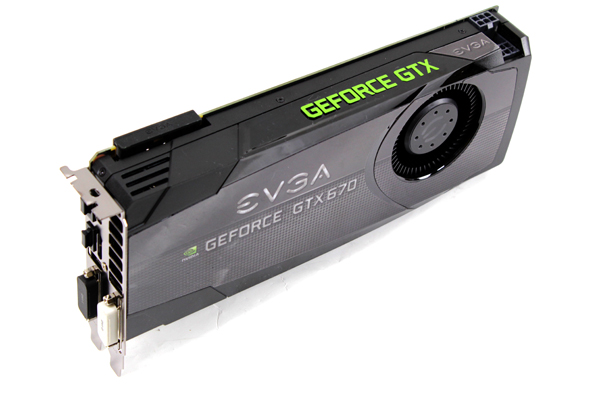
Our today’s task is to see whether EVGA’s GTX 670 FTW is really a graphics card for the win, or the FTW (For The Win) moniker is just a marketing ploy. Namely, we’re hoping the GTX 670 FTW will fare really well when it comes to noise, overclocking and, thanks to the high factory overclock, performance as well. If you’re looking at the picture below and wondering how can this be when EVGA used reference cooling, the trick is that this is reference GTX 680’s cooling. In fact, EVGA also took the reference GTX 680’s PCB as well.
670ftw1

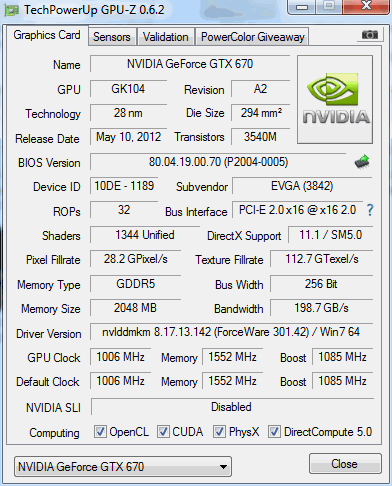
The GPU is overclocked from reference 915MHz to 1006MHz, while the memory is up from reference 1502MHz to 1552MHz (6208MHz effectively).
gpuz

GTX 670 and GTX 680 graphics cards use the GK104 GPU. EVGA set the GTX 670 FTW’s clocks at 1006MHz, which is the reference clock on the GTX 680. Naturally, performance can’t be the same because the GTX 670 comes with one SMX unit less. This means that the GTX 670 has 1344 CUDA cores while the GTX 680 has 1536 CUDA cores.

Both the GTX 670 and GTX 680 feature identical memory subsystems, packing four 64-bit memory controllers (totaling at 256-bit) and 2GB of GDDR5. As we already said, EVGA’s GTX 670 FTW comes factory overclocked.

  • «
  •  Start 
  •  Prev 
  •  1 
  •  2 
  •  3 
  •  4 
  •  5 
  •  6 
  •  7 
  •  8 
  •  9 
  •  10 
  •  Next 
  •  End 
  • »
(Page 1 of 12)
Last modified on Thursday, 07 June 2012 09:45
blog comments powered by Disqus

To be able to post comments please log-in with Disqus


Facebook activity

Latest Commented Articles

Recent Comments