Featured Articles

After USA Nvidia’s Shield comes elsewhere

After USA Nvidia’s Shield comes elsewhere

Project Shield, which is now called Nvidia Shield, is up for preorder, at least if you’re in North America. For…

More...
Nvidia won most Haswell high-end notebooks

Nvidia won most Haswell high-end notebooks

Our sources in the Far East are claiming that most Haswell notebooks that are coming out in the next few weeks…

More...
Microsoft officially announces the Xbox One

Microsoft officially announces the Xbox One

As announced earlier, Microsoft has now finally unveiled its next-generation console, the Xbox One. Although it did not shed much light…

More...
AMD poaches more Nvidia talent

AMD poaches more Nvidia talent

AMD has apparently managed to grab yet another high-ranking Nvidian, but this time it was no engineer or developer.

More...
HIS iCooler Turbo HD 7790 reviewed

HIS iCooler Turbo HD 7790 reviewed

Today we’ll take a closer look at a factory overclocked HD 7790, courtesy of HIS. The HIS HD 7790 iCooler Turbo…

More...
Frontpage Slideshow | Copyright © 2006-2010 orks, a business unit of Nuevvo Webware Ltd.
Tuesday, 04 September 2012 09:58

Club 3D HD 7970 GHz royalAce Edition reviewed - Thermals, Noise, Consumption

Written by Sanjin Rados

thumb

Review: Better cooling for GHz Edition and factory OC

Thermals and Noise

Thanks to the CoolStream technology, which involves a large heatsink, two fans and specially bent heatpipes, Club3D’s solution outperforms the reference one. The feat is all the more impressive considering we’re talking about a factory overclocked GPU here .

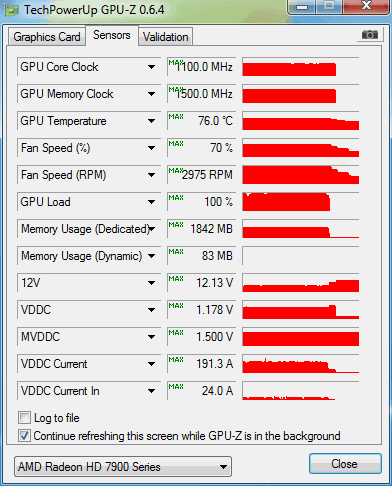
When idle, the GPU was around 39°C and the fans were quiet. After longer gaming sessions, temperatures climbed up to 76°C. When the card got hot, we could hear the fans easily (they ran at about 2900RPM), but they were still music to our ears compared to the overly loud reference solution.
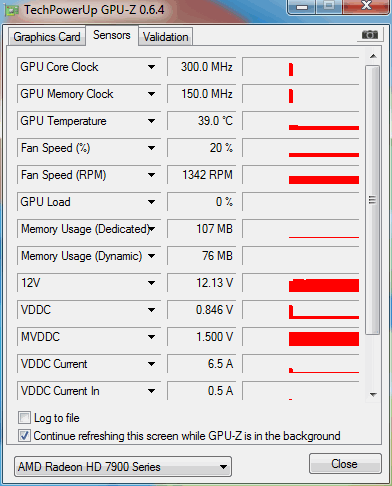
1 ace gpuz idle


1 ace temp load gaming

We had to remove the thermal paste that was on the base of the cooler, because it seems that the screws were a bit loose, which caused the paste to harden. Our first attempt at testing resulted in temperatures over 90°C, which was a clear indicator that something went wrong somewhere. Luckily, we fixed it and the cooler started showing its real face. We had no need for manual RPM settings, not even after overclocking, because auto-regulation ran just fine and temperature never exceeded 78°C. Our additional overclock made the fans louder, but not to the point where we’d call them too loud. 


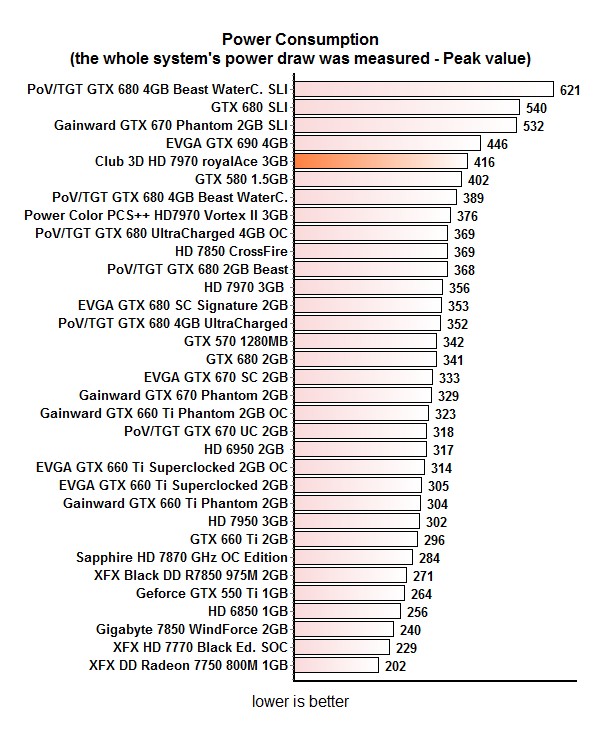
Power Consumption

AMD HD 7970 GHz Edition can draw significantly more power than the initially launched HD 7970 cards, which run at 925MHz.
power


(Page 11 of 12)
Last modified on Tuesday, 04 September 2012 10:37
blog comments powered by Disqus

To be able to post comments please log-in with Disqus


Facebook activity

Latest Commented Articles

Recent Comments