Featured Articles

Gainward GTX 780 3GB previewed

Gainward GTX 780 3GB previewed

The Gainward GTX 780 is now available priced at about US $649/€649, but we're hoping it will be available for a…

More...
GTX 780 available in US stores

GTX 780 available in US stores

The GTX 780, a trimmed down version of the Geforce Titan, is out and we wrote that almost a dozen…

More...
Newegg claims Shield comes on June 30

Newegg claims Shield comes on June 30

It is no secret that for the last few days you can pre-order Nvidia Shield, at least if you are based…

More...
Nvidia officially launches the GTX 780

Nvidia officially launches the GTX 780

Just as we wrote a couple of days ago, Nvidia has picked the 23rd of May as the official launch date…

More...
HIS iCooler Turbo HD 7790 reviewed

HIS iCooler Turbo HD 7790 reviewed

Today we’ll take a closer look at a factory overclocked HD 7790, courtesy of HIS. The HIS HD 7790 iCooler Turbo…

More...
Frontpage Slideshow | Copyright © 2006-2010 orks, a business unit of Nuevvo Webware Ltd.
Monday, 22 October 2012 07:10

Point of View / TGT GTX 660 Ultra Charged reviewed - GPU Boost and LLS

Written by Sanjin Rados

660-uc-thumb 

Review: Superior auto-overclocking


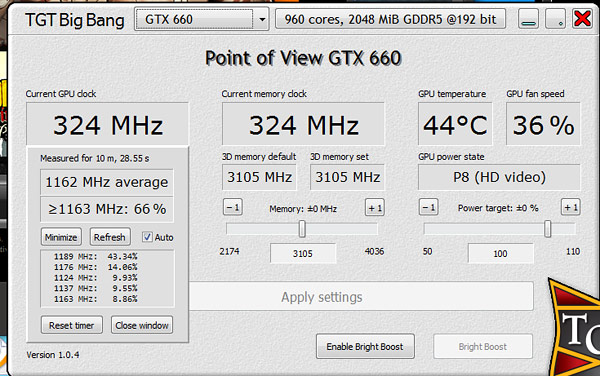
The UC boasts “Low Leakage Selection” GPUs so we checked it out with the recently launched GPU management utility Big Bang, which shows clock distribution during auto-overclocking.
660-UC--borderlands2

The highest GPU Boost clock on the GTX 660 UC was 1189MHz, while the GTX 660 SC’s was 1124MHz. We see a 65MHz difference in auto-overclocking, whereas the Base Clock difference is 39MHz. However, the UC’s clocks vary more often than on the SC. Below you see clocks we measured after half an hour of playing Borderlands 2.

GTX 660 UltraCharged clock distribution:

  1189 MHz:  32.25%
  1124 MHz:  12.30%
  1137 MHz:  10.05%
  1176 MHz:   9.87%
  1163 MHz:   8.34%
  1150 MHz:   8.30%
  1110 MHz:   7.62%
  1084 MHz:   6.07%
  1097 MHz:   5.10%
   550 MHz:   0.10%

GTX 660 SuperClocked clock distribution:

  1124 MHz:  95.90%
  1045 MHz:   3.65%
    550 MHz:   0.34%
  1110 MHz:   0.09%
  1071 MHz:   0.02%

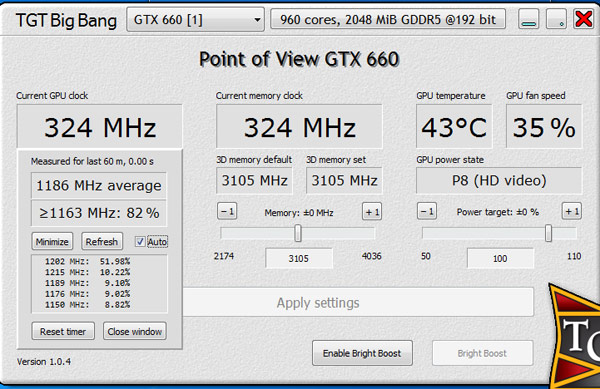
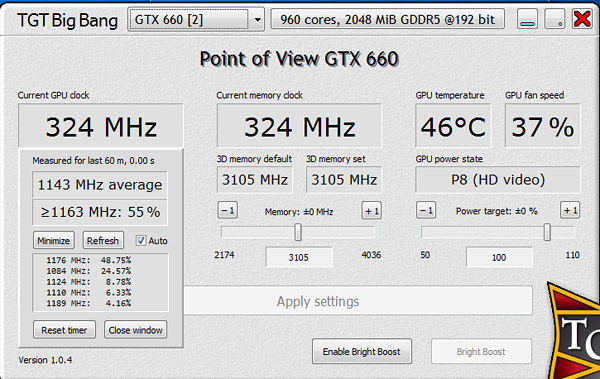
Once we tested SLI we measured even higher clocks on the second GTX 660 UC, up to 1228MHz. This means that not all LLS chips are the same either.
660-tgt-sli-card-1-boderlands2

660-tgt-sli-card-2-boderlands2

While it’s true that LLS GPUs had higher clocks, results clearly shows that it’s not a significant advantage. LLS GPU can of course be helpful in certain tests or attempts to max out GPU clocks.


(Page 5 of 7)
Last modified on Monday, 22 October 2012 07:36
blog comments powered by Disqus

To be able to post comments please log-in with Disqus


Facebook activity

Latest Commented Articles

Recent Comments