
Secrets
hidden in glue
As computer chips are growing in power,
more efficient cooling has to be applied. At the time being, the only "solution"
to this problem is mounting a better cooler on the chip. The problem is that
these coolers are the second stage of cooling, and chip cooling effectiveness
lies in the first stage which has proven to be a weak chain.
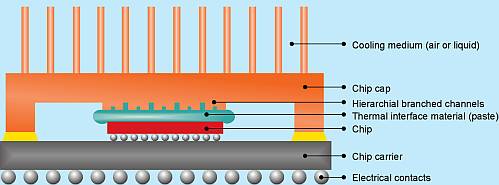
Schematics of the complete chip cooling (with mounted cooler)
At
the IBM Zurich Research Laboratory, scientists have found that heat transferring
efficiency can be dramatically increased if the heat transfer inside the chip
is redesigned. As you all may know, the chip consists of a microprocessor and a
cooling system. To connect these two systems to one, glue is used. To improve
glues heat conducting properties, it is enriched with metal or ceramic
particles. And here comes the main problem. A glue is a fluid.
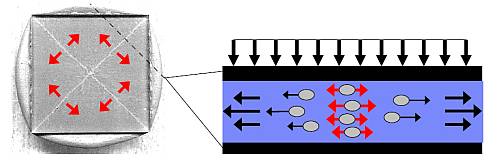
As you may see, heat conducting particles are not spreading evenly in all directions
The mixture of glue and the heat conductive
particles form a homogeneous fluid, but as you may know fluids have different physical
properties at different temperatures. When the mixture is applied to the
microprocessor the cooling system is put on top of it. Mechanical energy is
used to squeeze these two elements as near as possible. As we said, glue is a
fluid, and during the binding process id flows between these two elements filling
all the gaps. Problem that arises here is that the mixture loses its homogeneous
structure while the pressure and temperature rise. The heat conductive
particles are not forming a thin film, as they should. IBMs scientists have
found that these particles tend to pile up, leaving some areas "without
cooling".
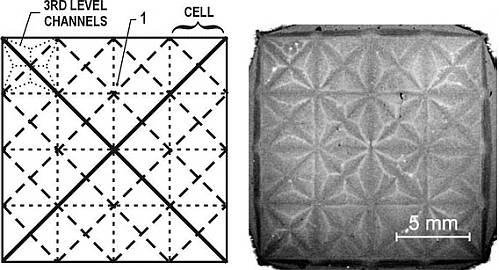
Micro channels look like irrigation channels – they should help in forming a thin and homogeneous layer of glue.
The solution to this problem is to "help"
the fluid (glue) to spread over the microprocessor evenly, forming a perfect
thin and homogeneous layer. Micrometer sized channels are going to be added to
the cooling system plate on the side facing the microprocessor. These channels
are going to act like irrigation channels, helping to transfer heat conductive
particles from "choking points" where they piled up to spots where
their concentration is below the need one.
The system will allow chip makers to use to three
times less glue with the reduction of thermal resistance by the factor of
three.


