
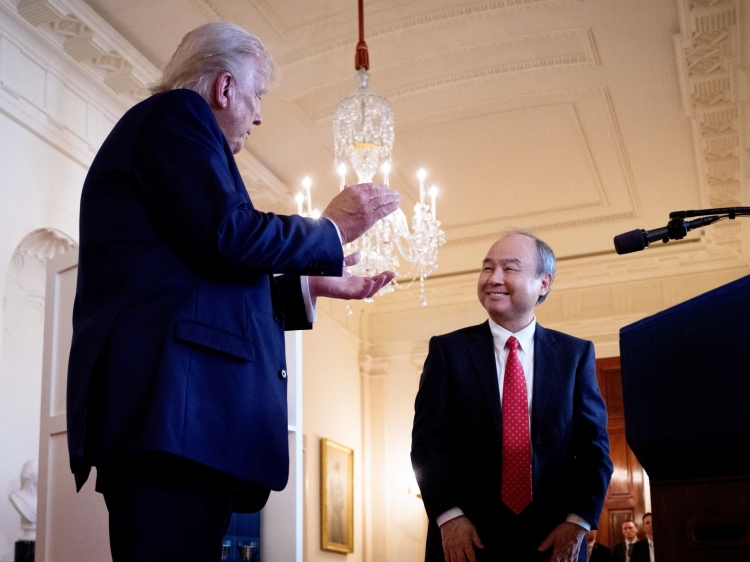
According to the Wall Street Journal, the billionaire SoftBank chief is puffing up dreams of reviving US manufacturing with Japanese cash and is trying to nail down a scheme that would plaster Trump’s name across industrial parks from coast to coast.
The plan follows months of chats with White House and Commerce Department officials and would funnel funds pledged under a recent trade deal into factories built on federal land.
President Trump’s enthusiasm for the whole thing was pushed out by White House spokesman Kush Desai who said: “President Trump’s relationships with business leaders across industries and geographies are playing a key role in securing the trillions in investments that are helping build America’s next Golden Age.”
Under the plan, SoftBank would help set up clusters of factories making fibre optic kit, data centre gear and AI chips. Japanese tech giants would supply expertise, while ownership of the shiny new facilities would drop neatly into federal hands once they are built.
Son, famed for his boom-and-bust Silicon Valley adventures, has long claimed SoftBank would ride the AI revolution, though he missed out on the early gold rush in generative AI. His more recent pledge of thirty billion dollars to OpenAI followed a long history of wild bets that made him rich, then made him look daft, then rich again.
Known inside SoftBank as Project Crystal Land, Son’s fantasy originally involved a one-trillion-dollar industrial city in the Arizona desert. He flogged the idea at a series of meetings with Commerce Secretary Howard Lutnick. During a summer pitch to Trump, Son painted a picture of robot-packed fabs pumping out chips while managers lived in desert housing the size of Los Angeles.
Officials said he aimed to fold the scheme into Trump’s “Freedom Cities” dream, although the administration’s interest in those has cooled. The mega city plan was then chopped into more manageable “Trump Industrial Parks” after the White House suggested smaller chunks might fly more easily.
Under a July trade deal, the US will scale tariffs on imported Japanese goods from 25 per cent to 15 per cent. Japan agreed to buy more US produce and slapped down a promised $550 billion investment in US strategic industries. Washington gets to pick where the money goes and keeps ninety per cent of any profit once Japan recoups its stake.
The White House's list of possible projects includes nuclear plants and hefty energy and AI infrastructure. Several overlap with Son’s own ideas, and Trump has pitched tens of billions of dollars' worth of partnerships with Japanese companies, including TDK, Mitsubishi Electric and Hitachi.
Whether any of this turns into concrete is unclear because the scheme needs staggering extra funds, approval to use federal land and someone to decide precisely what the factories will churn out. Son’s previous monster promise of a $500 billion OpenAI data centre project is still nowhere to be seen, and investors are muttering about an AI infrastructure bubble.
For the first phase, Son has chatted up Toshiba, Murata Manufacturing and Fujikura to build transformers, fibre cables and power modules. Toshiba said it regularly talks to SoftBank and is open to ideas. Murata and Fujikura stayed quiet.
Later phases involve building fab plants to take on companies in Taiwan, Japan and South Korea. Trumpworld wants to boost US semiconductor manufacturing, and Lutnick has already nudged Taiwan Semiconductor Manufacturing Co to invest more in the US. The firm lifted its US investment plans from $64 billion to $165 billion, although it reportedly brushed off SoftBank’s approach to join Project Crystal Land.
SoftBank’s stock has more than tripled since April, fuelled by its Arm stake and a spring investment in OpenAI that has almost doubled in value. Son made friends with Trump early. He stood beside the president-elect at Mar-a-Lago in December and pledged to spend $100 billion in the US over four years. On the second day of Trump’s second administration, he appeared at a White House presser alongside OpenAI supremo Sam Altman to announce a $500 billion data centre scheme called Stargate.
SoftBank also dropped $200 billion into Troubled Chipzilla in August, shortly before Washington took a ten per cent stake in the struggling outfit. That pushed SoftBank into a fiery turnaround effort that Trump and Lutnick now treat like a personal mission.
Lutnick has held talks with SoftBank and Interior Department officials about how much of the Crystal Land scheme can sit on federal land and how it might be powered and permitted. The whole push shows how Silicon Valley’s biggest names now queue up to flatter whoever they think holds the purse strings, reaching fresh levels of sycophancy without blinking.