Heat Buildup and Rotational Vibration
A recent
article written by Seagate
Technology storage expert David Szabados, Senior PR Manager responsible for enterprise storage, security, and future emerging storage technologies at the company, highlights the issue of rotational vibration in desktop and enterprise environments and its effects on data integrity. The article notes that the company has implemented numerous technologies over the decades in its multi-platter desktop and enterprise drives, including the Barracuda series, Constellation series and Constellation ES series, to negate the effects of rotational vibration. In particular, Seagate uses RV sensors as well as linear vibration sensors to compensate for any vibration that is generated from the drive. These sensors also cover environmental factors from outside of the drive, including cooling fans, chassis rigidity and other vibrational mechanisms. The company's larger capacity drives, including the Constellation ES 2TB, are built using a Top-Cover-Attach spindle motor that increases rigidity within any drive with a 4-disk configuration.
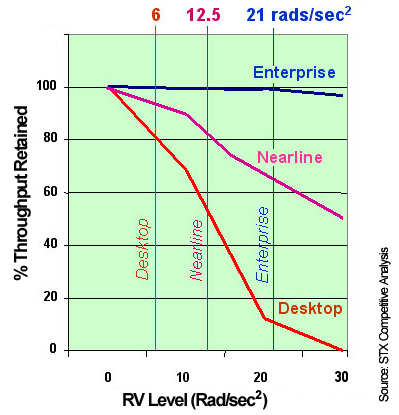
At first, we were a bit skeptical about the sustainable performance levels of these drives in relation to the amount of rotational vibration emitted during operation. Seagate notes, however, that when the rotational vibrations (RVs) increase beyond their specified tolerances, the performance of traditional desktop drives will drop dramatically, while enterprise-class drives will maintain consistent performance throughput under even moderately severe conditions. This led us to believe that while the drives may run hotter and produce more RVs than the Samsung Spinpoint F1s in comparison, the integrity structures that were engineered into the Constellation ES design framework give them a huge competitive advantage in enterprise environments where performance throughput is critical to sustainable operations.
Power
Consumption
One of the most important marketing points that
Seagate addresses throughout its Constellation ES enterprise storage ecosystem
is the PowerChoice
host-selectable power options. In theory, the feature is designed to tailor the
drive’s power savings settings for performance and power consumption via Set
Feature commands (on the SATA models) and via mode pages (on the SAS models). The
company implemented this feature to allow the drives to be flexibly configured
for optimal idle time thresholds. In other words, users are able to specify
exactly how long the drive’s command queue is empty depending on certain storage
application requirements. This is an ideal characteristic for high volume data
center environments where a mixed bag of applications are run on the same
drives during certain time slots throughout the day. Of course, the technology
wouldn’t be favorable if it didn’t have competition to live up to. In
comparison, Western Digital claims that its own proprietary Active Management
Feature can "monitor work load and automatically invoke idle mode whenever possible
to further reduce unnecessary power consumption.” The difference between the
two technologies is simply all about user control. With Seagate’s
implementation, the user is able to override the default PowerChoice timers and
manually configure them according to custom environmental variables. Western
Digital’s implementation, by definition, assumes itself to be a superior algorithm that is perfectly capable
of handling automatic power management.
Conclusion
Seagate has once again delivered a very robust and
highly reliable storage solution with its fourth-generation Constellation ES
series drives. With an engineering ethic built around providing exceptional
enterprise-oriented sustainability for high-volume database centers around the
world, we were presented these drives under the assumption that they would be
the absolute best-in-class for reliability measures. Indeed, they delivered on
this promise and went beyond our expectations by providing incredible RAID0
performance that we were not expecting to see. Although the Constellation ES
2TB drives tend to run quite hot and tend to produce more rotational vibrations
than the Samsung Spinpoint F1 RAID Edition drives we had for comparison, the
company has ensured that its RV sensors and linear vibration sensors will sufficiently
compensate for any vibrations coming from any outside environmental factors. In
addition, the inclusion of PowerChoice technology will ensure any IT managers
that these drives are fully configurable for a variety of application workloads
in the storage room and were engineered with mission-critical reliability particularly
in mind.
All in all, the Seagate Constellation ES ST32000644NS
2TB drive is currently the most reliable enterprise-class drive we have ever
tested. While the $300 dollar price tag may present the drive as a premium
product to some business professionals, it ultimately pays for the drive’s unparalleled
reliability and a continued investment into Seagate’s innovative product line
that continues to drive the storage industry forward at an incredibly rapid
pace.