
Video Playback
This is where the HD 3450 should make a world of difference, but
unfortunately it fails to deliver consistent results. Now, it's worth
pointing our that we're talking about performance out of the box, and
that we got a pre-production sample, and Asus has probably fiddled with
it a bit more over the past weeks.
The B204 struggles with some 720P formats, and 1080P in most formats is
a bridge too far for the little Eee. Without tweaking, 720P Matroska,
better known as .mkv, was not viewable, and neither were WMV or
QuickTime. If you're thinking installing new drivers could help, you're
right, but you can't download ATI's Catalyst 9.4, as it won't run on
the Asus. You have to get vendor specific drivers from Asus, and once
you install them, 720P is possible, albeit with relatively high CPU
utilization. However, 1080P is still impossible to enjoy.
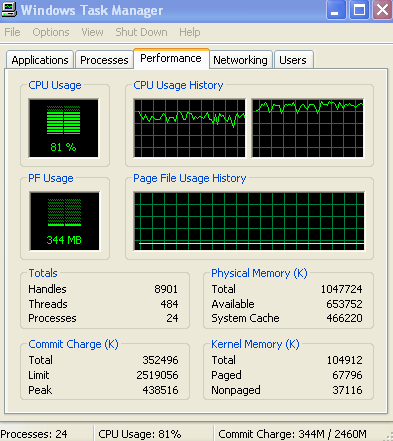
CPU utilization during 720P .mkv playback
In order to harness the power of ATI's UVD on the HD 3450, you need to
use DXVA, which, in XP, is only available through Catalyst 9.4. The
latest build of Media Player Classic Home Cinema (1094) supports DXVA,
and so do a number of commercial players, but you still have to watch
out for supported formats, codecs etc. It's all a bit too messy for a
rig aimed at the clueless consumer market, not at enthusiasts who would
try to play 1080P on a Spectrum Z80. If you struggle with HD playback,
here is a nice howtodo.
Needless to say, HD support is anything but comprehensive, although
we're sure Asus will offer some improvement through support software
and future driver versions. Also, we believe Vista would have been a
much better choice for HD, and it would be more future-proof.
Unfortunately, the idea of running Vista on any single-core Atom is
painful, ugly and slow, tantamount to letting me race Lance Armstrong,
uphill, after a night out on the town.
Conclusion
Obviously, the conclusion ends up being a bit, well, inconclusive. The
HD 3450 should be capable of delivering much more performance in terms
of HD decoding, and we're sure that Asus, or a lone, rogue geek, will
eventually put it to good use, and squeeze out that extra ounce of
performance needed to play 1080P in all flavours. True, it has a bit
less graphics power than the Ion, but in spite of that we believe it
should be able to take care of HD content. However, to provide consumers
with best possible HD experience, Asus should have used an HD 4000 chip
which has an improved UVD engine, 7.1 audio, and even an HD 43xx should
be on par with Ion.
Compared to the Acer Revo, the Eee Box B204 is a bit smaller, more
stylish, has a nice remote, and most importantly, it's almost silent,
whereas the Revo is pretty noisy. The Revo on the other hand has more
RAM (although the Eee Box B204 has discrete graphics with 256MB of
memory), a slightly faster CPU/chipset combo, and most importantly, it
runs HD out of the box, without tweaking, downloading and installing
drivers and watching out for codecs.
With 160GB hard drives, both systems lack storage as media center
solutions, especially in a time when some vendors offer up to 500GB on
their nettops, which don't have HDMI and aren't being marketed as media
centers. At least Revo has an eSATA connector, so you can add external
hard drives with the speed of an internal connection. If you've got a
NAS, this isn't an issue, but a USB only connection is slow, although
it will suffice for playback.
In his Revo review,
Eliot said he liked the concept of a small, power efficient Atom-based
media center, and he's not alone, I like the idea as well. Both Asus
and Acer have offered interesting alternatives to full blown HTPCs or
stand alone media players, but we found both to be far from perfect.
Acer went with Ion and Vista, Asus tried a discrete Radeon and XP.
Vista helps out a great deal in HD video playback, but you end up with
an overbloated OS on an underpowered machine. With Asus, you get a more
sensible OS, but you pay dearly, as it's crippled in terms of HD
performance, at least until Asus manages to fix some issues or until
you install Windows 7 RC.
In the end all we can say is that both of these systems bear promise,
but we would advise you to wait a few weeks for the vendors to mend
some flaws, and offer SKUs with more storage or even dual-core Atoms.
Better yet, if you're not in a hurry, wait for Windows 7, it's just a
few months away, and there's better things to do in the summer than
watch movies at home anyway.


